

All Saints Church with its commanding view of the ponds, is undoubtedly the place with the richest history in all of Carshalton. But what are the very oldest parts of the building? You’re going to find out…
We’re investigating the remaining parts of the original church that date way back to the early 1100s. The majority of the church you see from the ponds is of Victorian origin built circa 1892, but let’s uncover some of the more ancient history. Take a pew my friends…

An advantageous viewpoint
The distinctive church tower of All Saints is a focal point of Carshalton High Street. The tower foundations are the oldest surviving part of the church, dating back to circa 1100. The church at this time was owned by William the Conquerer, with 1084 being the very earliest known reference to a priest. It’s possible the tower dates even further back to Roman times, or was perhaps some kind of Viking watch tower originally. This would need further archaeological investigation.
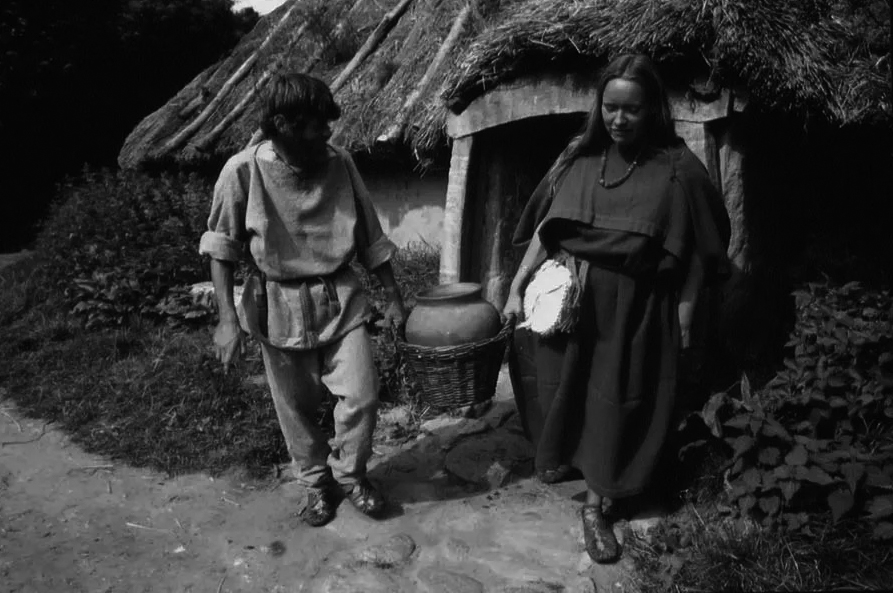
Meet the Norman congregation
During Norman times (1066 – 1154), Britain had a feudal system in which the wealthy prospered while the rest laboured on the land. Carshalton may have had some rich people in the congregation, but most of the population in England were poor, couldn’t read, and spoke old English. This was a language with a Germanic vocabulary, very different from modern English.
Pagan worship
Incidentally, there’s evidence of settlements in Carshalton dating to the iron age (400 to 100 BC), and it’s conceivable this area could have originally been a place of pagan worship. There was, for example, a farmstead close by, further up the hill at the corner of what is now Carshalton Park.

Became part of Merton Priory
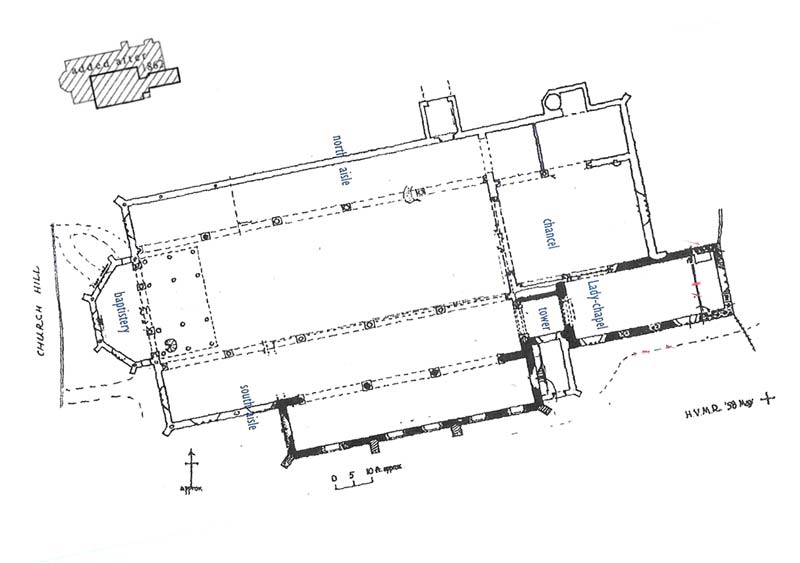
The church then went into the ownership of Merton Priory, founded in 1114. As you can see from the diagram above, All Saints church at this time was a lot smaller than it is now. The earliest record we have of a named priest is Alanus Presbyter in 1179, who was installed by Geoffrey de Manville, the serving Lord of the Manor of Carshalton.

Above, is the first known image of an All Saints priest. The early priests were part of Merton Priory, and it’s likely they lived at the church, probably in the church tower.
Fortunately, a lot of the original church from this time still exists. The chancel, where the vicar stands at the front of a church, is pictured below. It’s now named The Lady Chapel.
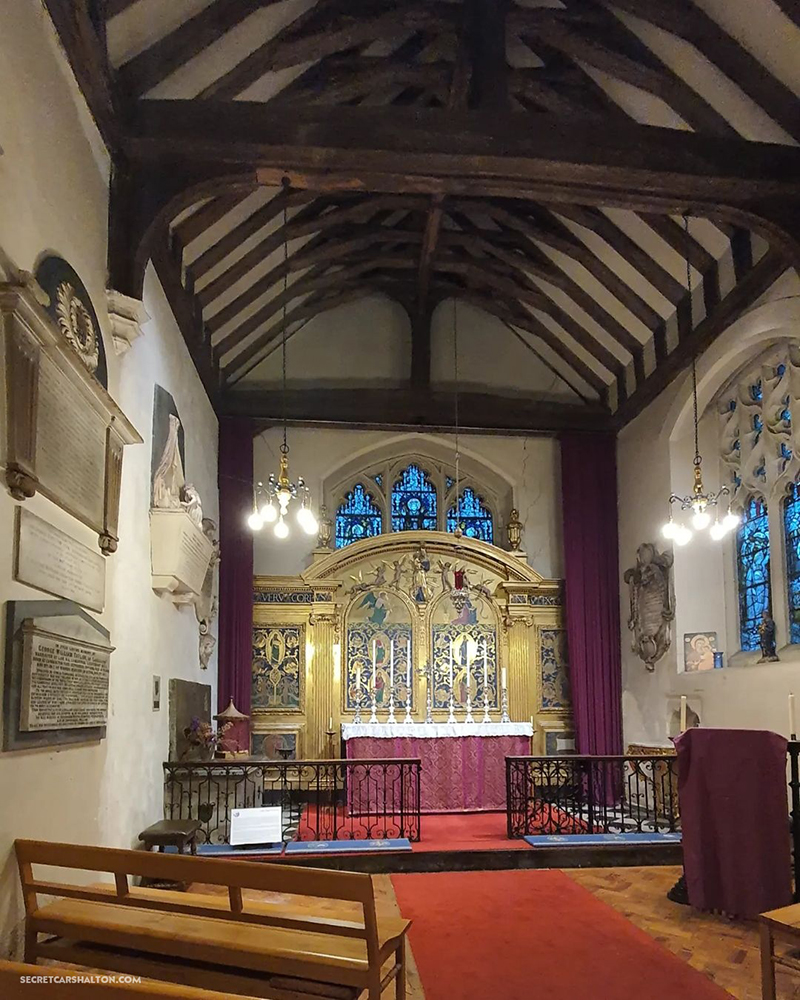
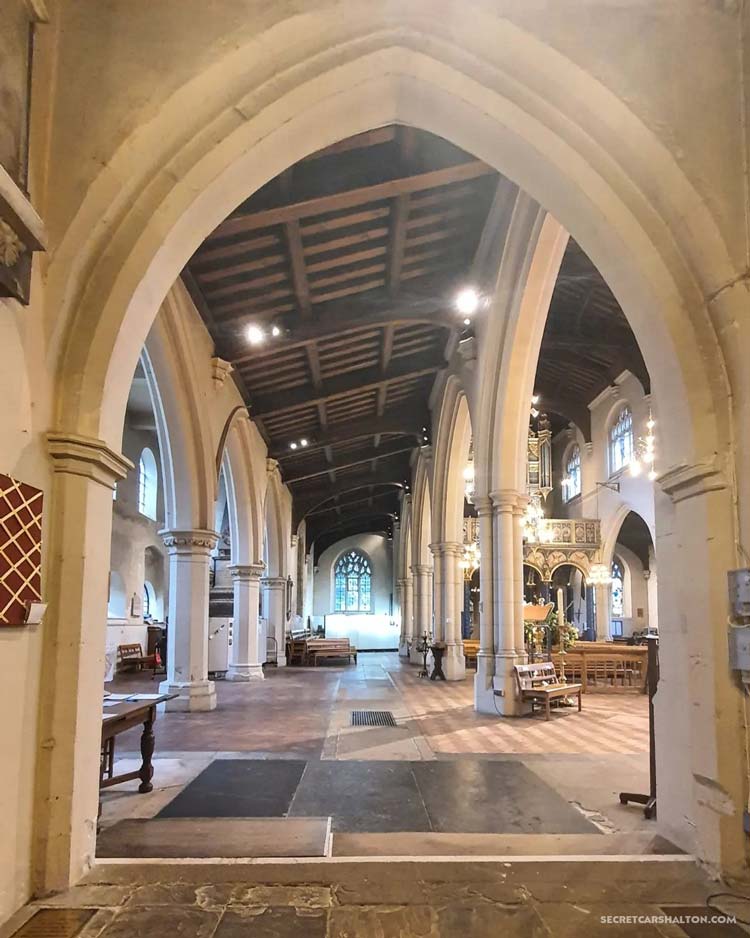
Looking out from the chancel, you can see the site of the original church aisle down the centre (known as the nave). Plus you can see some Norman columns, dated circa 1190, still intact on the left side.
Became Church of England
Merton priory was demolished in 1538, and although All Saints started out as a catholic place of worship it became under the jurisdiction of King Henry VIII following the formation of the Church of England in 1534.
The history continues
Inside the church are memorials to many well known figures from Carshalton’s illustrious past. Perhaps more on those another time.
We endeavour to get the facts as accurate as possible but are always happy to adjust if new info comes to light. Thanks to the Father David and churchwarden Andrew for showing me around. We hope you enjoyed this brief overview of All Saints’ early history. Found this interesting? Please let us know your feedback below.





I hope you do not mind me correcting a few elements of your article above. The first evidence for Carshalton is in the will of King Alfred when it is referred to as Aultone one of several variants of its pre 1205 name. It was in Alfred’s day a royal manor. By 1066 five thegns of King Harold possessed it, suggesting that around 1000 it was sold off to pay for the Viking wars. It must at that time 1066 been a large property as each thegn was required to have 120 acres of land, a Hall and a bell tower. During the Norman invasion it must have been trashed as by Domesday Book 85% of its pre 1066 value had gone. In 1086 it was held in part by Geoffrey de Mandeville and in part by Godfrey de Boulogne, the bastard son of Eustace II Count of Boulogne and step son of his wife St Ida, the father and mother of the first Crusader rulers of the Kingdom of Jerusalem. The church was held as part of the Honour of Boulogne and it was Faramus, friend and confident of Henry II and kinsman of the then bishop of Winchester, who appointed the priest you mention as the first known incumbent of the parish. During the Middle Ages, as you say, Merton Priory (it was never an abbey) appointed most of the then called vicars of Carshalton. This is generally but not completely true. On several occasions the Priory “farmed out” ie sold the right to appoint and on two occasions the appointment was taken by the then kings, Edward I and Edward III, and on one occasion it was given to the future Pope Paul II. You show a picture of the brass of Walter Gaynesford. He was though never a monk but a secular priest. He appears incidentally on two brasses… one of his own as he died in his mid 20’s and as a priest on his parents’ tomb, to the left of the Lady Chapel altar. I should add the additional point that the original church is likely to have been an Anglo Saxon church. The axial tower was probably a western tower, in common with the development of most Anglo-Saxon churches with towers in the Winchester diocese, which Carshalton was from circa 600 to the 1840s. The Lady Chapel was, although much altered, the original church. This is suggested by the fact that Anglo Saxon churches in this region were never orientated East West but rather ESE-WNW. It is suggested that this 18 degree kink is due to the angle of sunrise and sunset on the 1st of November, the feast of All Hallows as the church was known until Victorian times, now All Saints’. The Anglo Saxons tended to orientate their churches in alignment with the sun on the dedication day. But that is another story. I enjoyed your photos! Keep up the good work!
Thank you so much. All very interesting. Clarifications and corrections are very welcome indeed.